Most people are familiar with the Impressionist movement in some form, and those who are not are likely still familiar with paintings such as The Dance Class or Water Lilies. The movement’s distinctive visual language has shaped the way generations of artists and audiences think about painting, observation, and atmosphere.
On a personal level, I want to better understand not only Impressionism itself, but the conditions that allowed it to emerge and resonate so deeply. Why is it that The Cradle can move me in a way that a contemporary imitation of the same visual style often cannot? Why do some paintings capture the immediacy and emotional presence associated with Impressionism, while others reproduce only its surface appearance? Through this essay, I aim to explore Impressionism not simply as a style of painting, but as a fundamentally different way of perceiving and understanding the world.


What is Impressionism?
Impressionism is one of the most influential movements in Western art. Originating in mid-nineteenth-century France, it emerged through a group of young radical artists reacting against the rigid criteria promoted by the Parisian academies and endorsed by the French state. Rather than pursuing the polished illusionism of Academic painting, Impressionist artists sought to capture the fleeting atmosphere of lived experience itself. Visible brushstrokes and exaggerated colour palettes therefore became essential features of the movement, functioning not as imperfections but as tools through which light, movement, and sensation could be implied rather than clinically depicted.
During this period, it was widely believed that great paintings should contain allusions to mythology, classical literature, or biblical narratives. As a result, Academic painting often prioritised grandeur, idealisation, and historical spectacle over direct observation of the natural world. Landscapes became theatrical constructions rather than genuine encounters with place. Consequently, when artists began producing works that directly contradicted these values by painting ordinary life and transient atmosphere, the reaction from critics and artistic institutions was often severe.
Observe Figure 1, a painting by John Constable produced during the 1820s. When submitted to the Royal Academy of Arts exhibition of 1830, the work was criticised by fellow academicians for appearing unfinished. As noted by Ralph Skea in his text on Impressionism, critics found the painting “too brightly coloured and lacking in refined technique.” (Skea, 2019) By this, they referred to the impasto (thick applications of paint) visible within the highlights of the grass and water which defied the academic preference for smooth, blended surfaces achieved through techniques such as sfumato, scumbling, and grisaille. Within Academic painting, technical refinement was expected to conceal the physical presence of the artist, suppressing visible brushwork in favour of polished illusionism. Although celebrated today, the criticism directed toward Constable demonstrates the resistance faced by artists who departed from established academic conventions.
Let us now refer to Figure 2, a painting by Berthe Morisot in 1865 that exemplifies many of the defining characteristics of impressionism. Rather than constructing a polished illusion of reality, Morisot uses loose brushwork and fragmented colours to capture the fleeting atmosphere of a lived moment. The visible marks of the brush are not concealed beneath layers of refinement but instead remain active upon the surface of the painting itself. Consequently, the work communicates not only the appearance of a landscape, but the sensation of perceiving it directly. Through this rejection of academic finish, Morisot demonstrates how Impressionist artists began prioritising immediacy, perception, and personal experience over the rigid conventions upheld by the academies.


The Influence of Japanese Culture
Impressionism is one of the most discussed artistic movements in the Western world, and it would therefore be reasonable to assume that its key influences are equally well understood. However, during my research into the movement, I was struck by how often the significance of Japan is treated only briefly or as a secondary influence. This raised a broader question: to what extent can we understand an artistic movement without fully considering the cultural and historical conditions from which it emerged?
With that in mind, we must address the emergence of Japonisme in the West. In the mid-nineteenth century, Japan ended over two centuries of self-imposed isolation (sakoku) and opened its borders to international trade. This marked the first sustained encounter between Europe and Japanese visual and material culture in generations, resulting in a rapid influx of exported goods. As Ives notes, “shiploads of Oriental bric-à-brac – including fans, kimonos, lacquers, bronzes, and silks – had begun pouring into England and France.” (Ives, 2004).
For artists and audiences in Paris, this encounter between a highly codified academic art system and an unfamiliar visual language produced a profound shift in aesthetic thinking. Rather than an inevitable transformation, it was the convergence of these conditions – industrialised trade, expanding collections, and dissatisfaction with academic conventions – that allowed Japanese visual culture to exert such a significant influence. Artists associated with Impressionism and Post-Impressionism, including Monet, Van Gogh, Munch, and Toulouse-Lautrec, were particularly drawn to the flattened space, asymmetry, and focus on everyday subject matter characteristic of ukiyo-e prints.
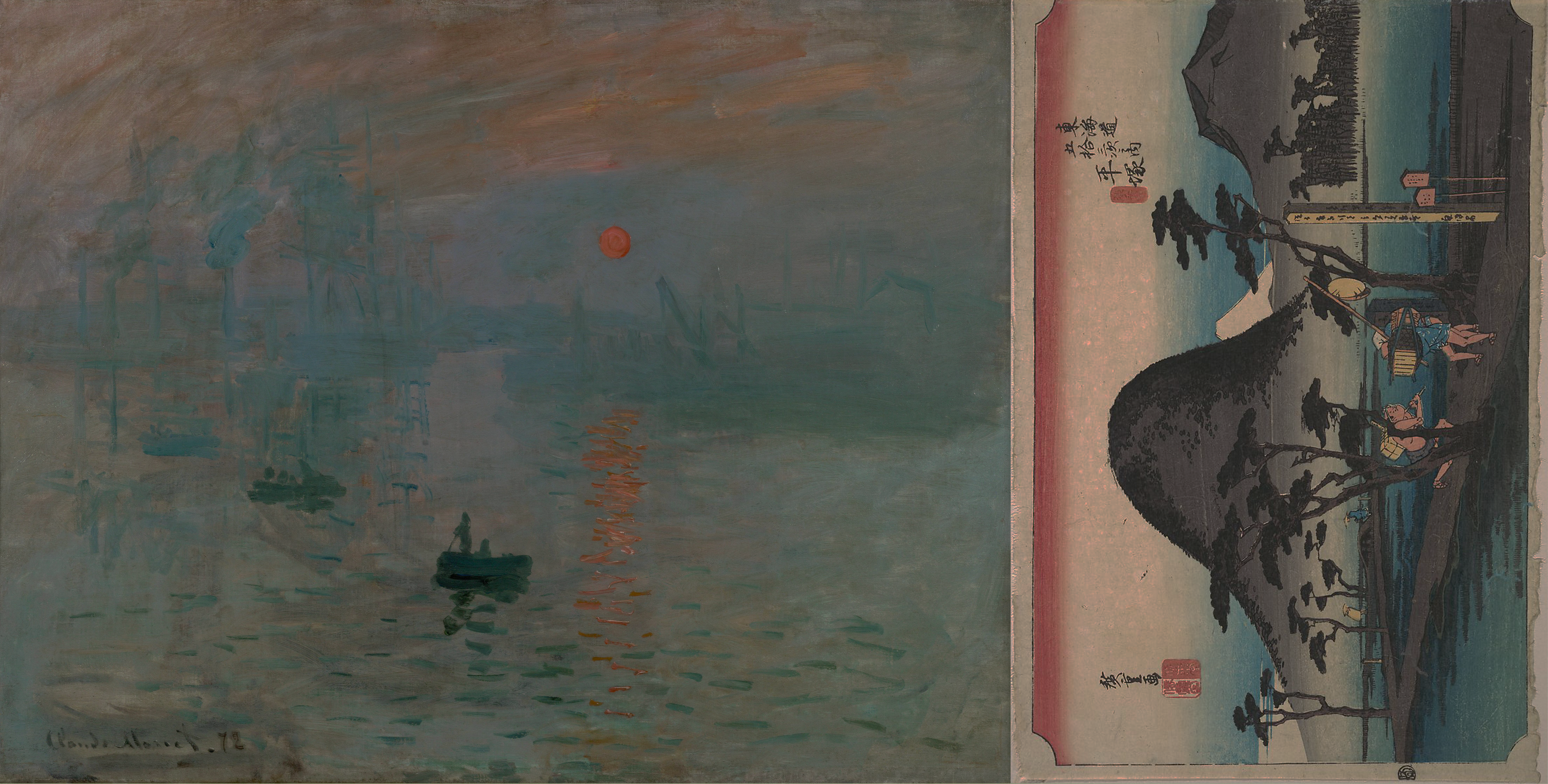
Notice the similarities between Figures 3 and 4, the first being a woodblock print by Hiroshige in 1856 and the other being an oil painting. This was one of the key influences that shaped the way Monet painted the world, following a compositional logic. In Monet’s impression, perspective works in layers that are clearly separated from one another and joined into the same plane through the use of a foggy atmosphere. The clearest object is the man on the boat in the foreground and each layer progressing back is an increasingly diffused presence in the scene. This same logic can be applied to the Hiroshige’s prints which constructed depth through layered planes. Both works imply space through a careful arrangement of colour, distance, and visual rhythm.
Utagawa Hiroshige was both a samurai and an ukiyo-e artist during the Edo period of Japan. By this stage in Japanese history, the role of the samurai had shifted away from military warfare and toward bureaucratic administration, and it was within this social structure that Hiroshige was born. Although samurai retained high social status within the feudal hierarchy, many faced financial strain due to fixed stipends, while merchant classes within expanding urban centres accumulated increasing economic influence.
Like many ukiyo-e artists, Hiroshige used printmaking as both an artistic practice and a commercial source of income. Through the mass production and circulation of woodblock prints, a rich culture of visual art emerged that reflected everyday life, landscape, and atmosphere. Hiroshige’s attachment to artistic observation and the world around him is evident in a poem written shortly before his death in 1858:
“I leave my brush at Azuma,
I go to the land of the west on a journey
to view the famous sights there.”
As previously mentioned, I believe it is more valuable to understand where and why a movement emerged than to know only its surface characteristics. In examining the social and cultural conditions surrounding artists such as Hiroshige, we better understand how Japanese visual traditions contributed to the transformation of Western painting. Hiroshige’s prints were only some of many Japanese works that entered Paris during the nineteenth century and helped reshape the way European artists approached perception, atmosphere, and composition.


My Interpretation of Impressionism.
Having researched Impressionism in depth, I decided to explore the movement through paintings of my own. Two works were produced: the first (Figure 5), a piece I believe succeeds in capturing the spirit of Impressionism, and the second (Figure 6), a work that I believe falls short. In comparing the two, I aim to conclude my evaluation of what Impressionism is fundamentally about.
The first painting, Study No.1: Flowers in the Evening, depicts a green field beneath an evening sky scattered with wildflowers. The visual links to Impressionism are immediately evident through the impasto brushwork, vibrant colour palette, and atmospheric simplicity of the subject. In that sense, the painting appears to possess many of the characteristics associated with Impressionist art. However, what ultimately gives the work emotional conviction is my personal connection to the scene itself. During the process of painting, I began to recognise my childhood garden within the image, and gradually the work transformed from a constructed landscape into a remembered experience. I can almost feel the cool May evening wind moving through the grass as a younger version of myself watches the sky remain bright long into the night. Because of this familiarity, the painting becomes something experienced rather than merely invented, and that closeness to the subject allows the work to communicate more honestly.
This is something I lacked while creating the second painting, Study No.2: Yellow Field at Night. Although the work demonstrates technical merit in many of the same ways as the first, there is a hesitation within the image that reflects my unfamiliarity with the scene itself. I do not dislike this work; I simply do not know it. Familiarity and direct observation were central to many Impressionist practices, which is partly why painting en plein air became so significant to the movement. For me, the second work demonstrates how stylistic imitation alone cannot fully capture the emotional immediacy associated with Impressionist painting.
In conclusion, I believe Impressionism is not defined solely by the way a painting looks, but by the artist’s ability to meaningfully inhabit the scenes they depict. In a culture that had long valued paintings for their connection to distant mythology and inherited narratives, Impressionism instead prioritised lived experience, atmosphere, and personal perception, permanently reshaping the way Western art understands reality and observation.
Reference List
Impressionism – Ralph Skea – Thames & Hudson – 2019
Japonisme – Colta Feller Ives – The Met – 2004 – metmseum.org
Merchants and Society in Tokugawa Japan. – Charles D Sheldon – Modern Asian Studies, vol. 17 no. 3, pp. 477-88 – 1983 – JSTOR.org
The Woodblock Prints of Utagawa Hiroshige: the Life of Hiroshige – Prof. Yone Noguchi – Japanese Government Railways – 1936 – Hiroshige.org



Leave a Reply